
Macroeconomic data, global market trends and trading activity of foreign investors will be the key drivers for dictating market sentiment this week, analysts said. "This week, volatility may increase ahead of the November derivatives expiry. Domestically, markets will track several high-impact macro releases, including Q2 GDP data and industrial production.

Moody's Ratings on Tuesday cut India's GDP growth projections for 2025 to 6.3 per cent, from 6.5 per cent, saying economies globally will see a slowdown on account of heightened US policy uncertainty and trade restrictions.

The country's largest listed auto parts company by market capitalisation, Samvardhana Motherson International, reported a better than expected operating performance in the second quarter (July-September) of 2025-26 (Q2FY26). Though the global passenger vehicle (PV) market is facing multiple headwinds, the company is outperforming on the back of higher content per vehicle and market share gains.

'We are profoundly energy-dependent on the Gulf. That dependency must now be redirected towards the United States, because we require American permission to procure oil.' 'We additionally require Iranian permission to acquire oil from that source. So India now has to seek two separate permissions merely to secure its energy supply.' 'Should we be compelled to source from America, or from Venezuela -- which is, in effect, American-controlled supply -- that will inevitably carry a price premium, an elevated shipping cost, and a considerably extended delivery timeline, given the distances involved.'
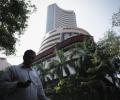
The broader NSE Nifty struggled before ending well above the 10,500-mark.

Indian economy is in a sweet spot, with a mix of solid growth and moderating inflation, Moody's Ratings said, forecasting a 7.2 per cent GDP growth in the 2024 calendar year and 6.6 per cent in the next. In its Global Macro Outlook 2025-26, the rating agency said the global economy has shown remarkable resilience in bouncing back from supply chain disruptions during the pandemic, an energy and food crisis after the Russia-Ukraine war began, high inflation and consequent monetary policy tightening.

The Budget emerges as a measured, credible and forward-looking policy document that reinforces India's commitment to remaining a stable, reform-oriented economy amid an increasingly fragmented global landscape, says A Balasubramanian.

Macroeconomic data announcements, global trends and trading activity of foreign investors would be major driving factors for market movement this week, analysts said. Unabated capital infusion by domestic institutional investors have supported the positive trend in the stock market last week, traders said.

West Asia conflict triggers sharp sell-off in Indian markets, with realty, banking and auto stocks leading losses amid energy shock fears.

Analysts at Morgan Stanley have updated their outlook for the Indian markets, and they now expect the Sensex to hit the 107,000 mark by December 2026 in a bull-case scenario, translating into an upside of 26 per cent from current levels.

Foreign investors continue to show confidence in the country's equity market, infusing Rs 14,167 crore so far this month, largely driven by favourable global cues and robust domestic fundamentals. Notably, this inflow has come despite the ongoing military tensions between India and Pakistan.

India's $280-billion IT industry heads into 2026, balancing visa-related headwinds and global trade uncertainty against its biggest-ever push into artificial intelligence and the rapid expansion of global capability centres (GCCs). Heightened scrutiny of the US H-1B visa programme - including a proposed $100,000 fee for new visas and concerns over a potential 25 per cent outsourcing tax - has complicated cross-border delivery for Indian firms, even as companies accelerate efforts to reduce reliance on onsite staffing.

The recent correction suggests that while precious metals hedge geopolitical tension and inflation, they are not immune to sharp short-term corrections and profit-booking.

Gold prices are likely to remain under pressure in the coming week as investors await key US macroeconomic data for cues on the Federal Reserve's potential direction on interest rates, which in turn will influence the trajectory for the precious metal, according to analysts. Market sentiment has tilted away from safe-haven assets like gold amid fading geopolitical tensions and improving risk appetite towards riskier assets such as equities, they said.
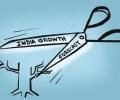
Moody's on Friday slashed India's GDP growth projections for 2022 to 7 per cent from 7.7 per cent earlier as the global slowdown and rising domestic interest rates will dampen economic momentum. This is the second time that Moody's Investors Service has cut India's growth estimates. In September, it had cut projections for the current year to 7.7 per cent from 8.8 per cent estimated in May. "For India, the 2022 real GDP growth projections have been lowered to 7 per cent from 7.7 per cent.

Assessing where their funds are flowing gives traders a hidden edge in predicting the market direction and momentum.
In an event-heavy week ahead, stock markets' movement would highly depend on macroeconomic data announcements, global trends, RBI's interest rate decision and trading activity of foreign investors, analysts said. India's industrial production data for October 2025 will be released on December 1, an official statement said on Friday.

Is the parabolic rise in silver running out of steam or just getting started? Ramalingam Kalirajan offers his take on if you should invest in silver now?
Stock markets will be driven by RBI's interest rate decision, tariff-related developments, global trends and trading activity of foreign investors in this holiday-shortened week, analysts said.

Moody's Investors Service on Friday raised India's growth projection for 2023 calendar year to 6.7 per cent on account of robust economic momentum. "Strong services expansion and capital expenditures propelled India's 7.8 per cent real GDP growth in the second (April-June) quarter from a year ago. "We have accordingly raised our 2023 calendar year growth forecast for India from 5.5 per cent to 6.7 per cent," Moody's said in its Global Macro Outlook. - el nino

'New investors should enter gradually and stay cautious.' 'Silver is a structural multi-year story, but timing matters in a high-volatility metal.'

Fitch Ratings on Monday affirmed India's sovereign rating at 'BBB-', with a stable outlook, saying a strong record of delivering growth and improving fiscal credibility will drive improvements in structural metrics. "India's ratings are supported by its robust growth and solid external finances," Fitch said, as it forecast GDP growth of 6.5 per cent in the fiscal year ending March 2026 (FY26), unchanged from FY25, and well above the 'BBB' median of 2.5 per cent.

'An asset must generate income. Equities yield dividends, bonds pay coupons, deposits give interest, and real estate earns rent.' 'Gold, silver, and even Bitcoin produce no income, they merely store value. So, they should not be compared to productive assets.'

Largecap equity funds remain suitable for conservative and moderate risk-taking investors seeking relatively stable returns.

'There are new job roles that are emerging because of AI.'

Gold's glittering rally is expected to continue, with prices likely to climb towards $4,500 per ounce in overseas markets, supported by sustained global central bank purchases, persistent geopolitical tensions, and strong Asian demand, according to a report by Motilal Oswal Financial Services Ltd. Silver, which has outperformed gold in terms of returns so far this year, is projected to climb to around $75 per ounce, aided by robust industrial consumption and a widening supply deficit, the report said.

Among Sensex firms, Mahindra & Mahindra, Tata Motors, Trent, Eternal, Asian Paints and Infosys were the major gainers. However, Sun Pharma, ITC, Hindustan Unilever and Titan were among the laggards.

New Delhi will substantially reduce tariffs on industrial and agricultural goods while continuing to protect sensitive sectors. Tariffs on some agricultural products that are not traditionally considered sensitive will be brought down to zero, while in the case of relatively sensitive items, duties will be reduced in a graded manner and quotas will be imposed.
Trading sentiment in the equity market will be guided by macroeconomic data announcements, global trends and quarterly earnings from IT major TCS this week, analysts said. Stock markets would also be tracking trading activity of foreign investors who remained net sellers of Indian equities in September.

'Exiting during corrections tends to lock in losses. Patient investors have benefited from holding through similar drawdowns in past cycles.'

'We continue to view India as a standout within EM.'

'Calibrated depreciation will help rebalance external fundamentals, offset some of the tariff differentials with competitors, improve the competitiveness of domestic substitutes vis-a-vis Chinese imports, and contribute to the easing of financial conditions at a time when the inflation rate is unusually low,' explains Sajjid Z Chinoy, head of Asia Economics at JP Morgan.

Apart from supply chain disruptions, Moody's also expects consumption and investment to be affected and prices of oil and other commodities to remain around current lows until the end of June.

From the Sensex firms, Tata Motors jumped the most by 5.54 per cent, followed by Kotak Mahindra Bank, Trent, Sun Pharma, Axis Bank, and ICICI Bank. However, Bajaj Finance, State Bank of India, UltraTech Cement and Tata Steel were among the laggards.

India's top IT services firms delivered single-digit revenue growth in April-June, capping off a mixed, somewhat-sobering quarter as macroeconomic instability and geopolitical tensions weighed on global tech demand and delayed client decisionmaking. Management commentary painted a mixed picture, caution prevailed, yet industry CEOs also emphasised cost optimisation, vendor consolidation, and opportunities in AI makeovers.

Investors in India's information technology (IT) companies are likely in for more pain ahead as muted earnings for the first quarter of 2025-26 (Q1FY26) play spoilsport at the bourses in the worst-performing sector this year amid macro uncertainties. Investors, analysts suggest, can look for better opportunities in the markets as things stand.

'The primary market's rhythm mirrors investor confidence. While sentiment may appear cautious, it reflects maturity, not weakness.'

Moody's on Thursday slashed India's growth estimate for the current year to 9.1 per cent, from 9.5 per cent earlier, saying high fuel and fertilizer import bill could limit the government's capital expenditure. In its 'Global Macro Outlook 2022-23 (March 2022 Update): Economic Growth will suffer as fallout from Russia's invasion of Ukraine builds' report, the rating agency said Russia's invasion of Ukraine has significantly altered the global economic backdrop through three main channels -- spike in commodities prices, risks to global economy from financial and business disruption and dent in sentiment due to heightened geopolitical risks. It said Russia is the only G-20 economy that will contract this year and forecast that its economy will shrink 7 per cent in 2022, and 3 per cent in 2023, down from projected growth of 2 per cent and 1.5 per cent respectively, before the invasion of Ukraine.

Facing criticism from the government over the central bank prioritising inflation over growth, the new RBI Governor Sanjay Malhotra on Monday said that prospects of the Indian economy are expected to improve on the back of high consumer and business confidence in 2025. "As we strive to preserve financial stability to support a higher growth path for the Indian economy, our focus remains steadfast on maintaining stability of financial institutions and, more broadly, systemic stability," Malhotra said in foreword to the Financial Stability Report.

Sanjay Malhotra has made structural changes to banking regulation to bring down costs and increase efficiency. Plus, he kicked off a benign interest regime. But there are challenges ahead.
